Why does proficiency training matter? Every year thousands of pilot certificates are issued by the Federal Aviation Administration (FAA). These issuances result from hard work and dedication from flight students nationwide. Pilot ratings are the same across the country. However, prospective pilots can take many different routes to earn them. Some routes take longer than others, some are FAA-approved, and some are unique. At Axiom Aviation, proficiency training is our focus. We teach beyond the minimum standards, so students earn their ratings and become great pilots.
Two Categories of Flight Schools
The FAA has established two sets of regulations that students must follow to obtain their ratings. The first is Part 61. Under Part 61 students must meet certain requirements and pass an exam with a Designated Pilot Examiner (DPE). Students may train with an independent Certified Flight Instructor (CFI). Alternatively, they may train with a flight school that follows Part 61 regulations. These schools and instructors can teach as they see fit. Still, every student must pass the FAA exams to earn a rating.

The other set of regulations is Part 141. Under this part, students may attend a Part 141 flight school that follows an FAA-approved Syllabus. These schools are typically associated with universities. These programs have some perks. However, they usually take longer and cost more than Part 61 programs. These students follow an FAA-approved syllabus. Even so, they take the same exams as Part 61 students and receive the same rating. We recently did a full breakdown of the differences between Part 61 and Part 141 schools which you can check out here.
Length of Flight Training
The length of flight training varies. Most full-time students finish in 1 to 2 years. Full-time students at Axiom Aviation usually finish in about 1 year. Students with more availability can finish even faster. There are select Part 61 programs that allow students to complete their ratings in well under a year. However, it should be noted that many of these programs offer sub-par flight instruction. The instructors are not the problem. Instead, these curriculums focus only on meeting minimum requirements and passing tests.

As a result, students in these programs often repeat the same maneuvers and landings in the same places. While practice makes perfect, it should be noted that situations change and no two landings are ever the same. Aviation is always changing. Repeating the same maneuver at the same spot on clear days can help a student pass a checkride. However, it does a poor job of preparing them for varied conditions.
A Better Way to Train
First, the Airman Certification Standards (ACS) set what students are tested on and the limits for each maneuver. At Axiom Aviation we strive to train students to exceed standards as we train for proficiency. We still train students to pass their tests. Thanks to proficiency training, though, our graduates leave with richer experience. As a result, they are better prepared for adverse conditions.

Proficiency Training for Short-Field Landings
A great example of this is how we train students for landings. One of the landings Private Pilot Students will be tested on is known as the Short-Field landing. This landing requires a student to pick a spot on the runway and land on that spot. This maneuver prepares students to land on a short runway, which may require the full length. Some schools push students through as fast as possible. Their students often practice landings at only one or two airports, on the same runway point every time. At a proficiency-based school, students fly to dozens of airports. They learn to control the aircraft and manage energy so they can land on any point of any runway.
Cross-Country and Mountain Flying
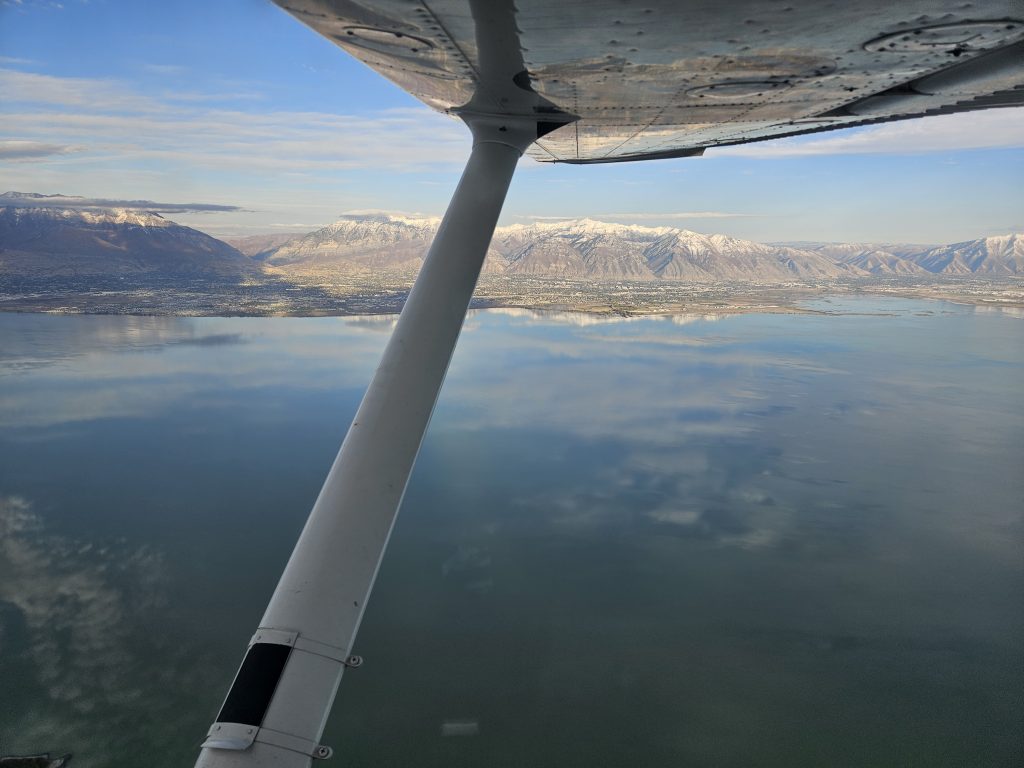
Another appropriate example would be cross-country flying. Cross-country flights are defined as flying to another airport that is at least 50 miles away. Here at Axiom, we fly all over the western US taking students to unique and challenging airports in an attempt to prepare them for a variety of flight circumstances. Many number-focused schools restrict their students to flying to a limited number of predetermined airports. These airports typically have large runways and are in open valleys. This is a very safe approach to flight training. Even so, pilots must learn to handle difficult terrain, so Axiom places a big focus on mountain flying.
Stay Safe and Fly Proficiently
At Axiom our primary focus is safety. Everything we do is to train safe and proficient pilots. In other words, we push students through harder situations so they are ready for what comes later.
Have any questions on proficient flight training? Give us a call at 262-297-4568. Or email us at info@flyaxiom.com
For official rules and guidance, review the FAA’s Become a Pilot resources and the FAA Pilot’s Handbook of Aeronautical Knowledge.