
Your first solo flight is based on proficiency, not a magic number of flight hours. The FAA requires the right eligibility documents, knowledge test, logged training, aircraft-specific endorsement, and instructor approval. Follow these steps before you take command of the aircraft.
Use 14 CFR 61.87 with your authorized instructor as the starting point. It covers pre-solo knowledge, logged training, demonstrated proficiency and the current make-and-model endorsement. Your documents, medical eligibility and additional permissions must also match the flight you intend to make.
Step 1: Confirm Your Age, Student Pilot Certificate, and Medical Eligibility
The first step in meeting student pilot solo requirements is confirming that you can legally act as a student pilot. For airplane training, you must be at least 16 years old. You also need to read, speak, write, and understand English.
You don’t need a student pilot certificate to begin lessons. You do need one before you fly solo. Most students apply through IACRA with help from their flight instructor or flight school. The application can also go through an authorized aviation representative, a designated pilot examiner, or an authorized representative at a Part 141 school.
The student pilot certificate and medical certificate are now separate documents. Your student certificate does not expire after issuance, but it will be replaced when you earn a higher pilot certificate. Review the student pilot certificate requirements early so a paperwork delay doesn’t hold up your first solo.
| Checkpoint | What to confirm | Why it matters before solo |
|---|---|---|
| Age | At least 16 for airplane solo | This confirms the minimum age requirement for airplane solo. |
| Student pilot certificate | Application submitted and certificate received | You can’t solo without the certificate. |
| Medical certificate | Meet the medical requirement or permitted alternative for the intended operation | Your instructor must know you meet medical eligibility rules. |
| English ability | Read, speak, write, and understand English | Clear communication supports safe solo operations. |
A third-class medical certificate is the common baseline discussed by flight schools for private-pilot training. The exact medical path can depend on your goals and circumstances. If you want an airline career, consider getting medical advice early instead of waiting until advanced training.
You can find the application information on the student pilot certificate page, including where an application may be submitted.
Milestone: By now, you should have a student pilot certificate plan, a medical certificate path, and a clear answer about your eligibility.
Step 2: Complete Pre-Solo Ground and Flight Training
Pre-solo training turns the legal checklist into usable skill. Before operating alone, a student pilot completes aeronautical knowledge and logged flight training.
Start with the knowledge test given by your authorized instructor. It must cover the applicable parts of Federal Aviation Regulations Parts 61 and 91. It also must cover the airspace and procedures at the airport where you’ll solo. Your aircraft’s flight traits and operating limits are part of the test too.
Don’t treat this as a box to check. If you miss questions, your instructor must review the wrong answers with you before authorizing solo flight. That review matters because a student may understand a rule in a quiet classroom but miss its use during a busy airport departure.
For a single-engine airplane, your logged training normally includes these skill areas:
- Preflight planning, aircraft systems, and engine operation
- Taxiing, runups, and surface movement
- Normal and crosswind takeoffs and landings
- Straight-and-level flight, turns, climbs, and descents
- Traffic pattern entry and departure
- Collision, windshear, and wake-turbulence avoidance
- Slow flight, stall recognition, and stall recovery
- Emergency procedures and equipment malfunctions
- Ground reference work, simulated engine failures, slips, and go-arounds
Your instructor must see satisfactory skill and safe judgment in the aircraft make and model you plan to fly. Training in a similar aircraft may count in some cases, but don’t assume the change is automatic. Ask your instructor what must be repeated after a fleet change.
There is no FAA rule that sets one universal number of flight hours before first solo. One student may need more pattern work. Another may need more time with radio calls or emergency drills. Axiom Aviation can help future aviation professionals build a structured path toward the PPL instead of chasing an hour target without knowing what skill remains.
Keep your own notes after each lesson. Write down the maneuver that needs work and the condition that made it hard, such as a crosswind or a rushed approach. That gives your next lesson a clear purpose.
Milestone: By now, you should have passed the instructor’s pre-solo knowledge test and logged every required area for your aircraft.
Step 3: Obtain the Required Instructor Endorsements
An instructor endorsement is the written permission that makes a solo flight legal for the student pilot. It is one of the most important student pilot solo requirements because passing a lesson alone does not give you solo privileges.
Your flight instructor must assess your knowledge, control skills, decision-making, and safety habits. The endorsement goes in your logbook. It should match the aircraft make and model you will fly. If you move into another aircraft type, ask whether a new endorsement is needed before you solo again.
Under 61.87(n) and (p), solo privileges require a logbook endorsement for the specific aircraft make and model, with the required training and endorsement recency. The instructor must update the endorsement every 90 days for continued solo privileges. Verify its date before each solo. Cross-country and night solo flights have additional requirements; a local daytime endorsement does not authorize every flight.
Review the endorsement with your instructor before signing anything. Check the aircraft limits, airport or area limits, date, and any other conditions. A clear logbook record helps you answer questions during later training and prevents confusion after a change of instructor.
For students planning an airline career, Axiom Aviation pairs early milestones with the larger training path. Your first solo is only one point on the route toward a private pilot certificate, instrument rating, commercial certificate, and later airline eligibility. You can also review the pilot career path from student to airline pilot when planning beyond this first flight.
Don’t pressure an instructor for an endorsement because another student soloed first. Readiness is personal. A student who can land well in calm air may still need more work when the wind shifts, traffic increases, or a radio call arrives at the wrong moment.
Milestone: By now, your instructor should have signed the logbook for the correct aircraft and defined where and how you may solo.
Step 4: Prepare for the First Solo Flight
Preparation makes the first solo feel like a known routine instead of a surprise. The final student pilot solo requirements are only part of the work. You also need a plan for the airport, weather, aircraft, and your own focus.
Before leaving the ground, review the exact traffic pattern you’ll use. Know the runway in use, expected wind, traffic flow, radio calls, and nearby landmarks. Brief the departure, pattern entries, rejected landing, go-around, and return plan with your instructor.
Use a short personal checklist:
- Check the weather against your instructor’s limits.
- Inspect the aircraft and confirm required documents are aboard.
- Review normal and emergency checklists.
- Write down key frequencies and pattern information.
- Confirm fuel, runway condition, and traffic expectations.
- Tell your instructor if you feel rushed, ill, or distracted.
Sleep well before the flight and eat something light that you know agrees with you. Too much caffeine can add to nervousness. You want enough energy to think clearly without adding another problem to the cockpit.
The safest first solo is often a simple one. Many instructors supervise a few traffic-pattern takeoffs and landings from the ground. The goal is steady control and good judgment, not a dramatic route. If an approach feels unstable, go around. A go-around is a normal safety action, not a failure.
Weather can change the plan even after the endorsement is complete. Wind, visibility, runway conditions, or traffic may make another day the right choice. Your endorsement does not force you to fly. You still make the final go or no-go decision within your instructor’s guidance and the applicable rules.
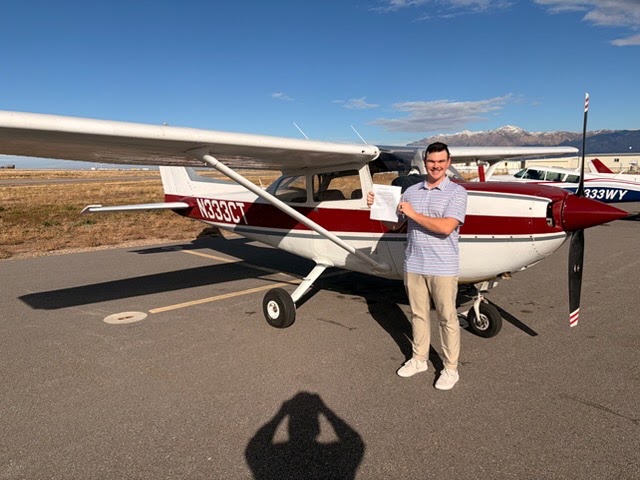
At Axiom Aviation, we tell students to treat the first solo as a safety exercise with a proud moment attached. Stay ahead of the airplane. Use the checklist. If the picture changes, choose the safer option.
Milestone: By now, you should have a weather decision, airport plan, aircraft check, and go-around plan that you can explain out loud.
Step 5: Complete, Log, and Maintain Solo Flight Privileges
After the flight, finish the record while the details are fresh. Log the date, aircraft identification, route or pattern work, total time, and solo time in the format your instructor requires. Then review the flight with your instructor.
Write down what went well and what needs work. Maybe your altitude stayed steady but your radio calls felt late. Maybe the landings were sound but your preflight took too long. A useful debrief turns one solo flight into a better next lesson.
Keep your logbook and endorsements safe. The endorsement is part of the record that supports your solo privileges. If you lose a logbook, change schools, or switch instructors, tell the new instructor before planning another solo flight.
Your privileges can have limits. Local solo approval does not automatically permit solo cross-country flight. A separate cross-country endorsement is required after the related planning, navigation, and flight training are complete.
Check endorsement currency before every solo, including the 90-day limit, and reassess after a break or change of aircraft. Your instructor may require further training before renewing permission. Do not treat an old endorsement as valid simply because the student pilot certificate has not expired.
Use the same habit as training moves toward the private pilot checkride: study the rule, practice the skill, record the result, and ask what comes next. Students who plan to continue toward airline work can keep that record aligned with the broader pathway discussed in Axiom Aviation’s pilot pathway program guide.
The first solo is complete when the aircraft is parked and the paperwork is accurate. The learning is not. Your next goal may be more solo patterns, local practice, or preparation for cross-country work.
Milestone: By now, your solo flight should be logged, debriefed, and followed by a clear next lesson.
FAQ: Student Pilot Solo Requirements
What is the minimum age to solo an airplane?
The minimum age to solo an airplane is 16. You must also meet the student pilot certificate rules, complete the required training, pass the instructor’s knowledge test, and receive an endorsement. Glider and balloon rules differ, so confirm the age requirement for the aircraft category you plan to fly.
How many flight hours do you need before solo?
No single fixed number of hours applies before a first solo. Your instructor decides when you show the required knowledge, proficiency, and safe judgment. Flight schools may share typical ranges, but those are planning estimates rather than a universal legal threshold. Weather, aircraft type, airport traffic, and lesson frequency can all affect timing.
Do you need a medical certificate to solo?
For ordinary airplane training toward private-pilot privileges, a third-class medical certificate is a common route. However, 61.23 includes exceptions and alternatives, including qualifying sport-pilot or BasicMed operations and glider or balloon training. Confirm the exact rule with your instructor and an Aviation Medical Examiner; not every student solo requires an FAA medical certificate.
Can a student pilot solo in any airplane?
No, a student pilot must have the right training and endorsement for the aircraft make and model used. A new airplane may have different systems, handling traits, or operating limits. Ask your instructor before changing aircraft. The required endorsement and any review training should be clear before you fly alone.
Do you need a separate endorsement for solo cross-country flight?
Yes, solo cross-country flight requires a separate endorsement. Your instructor must verify the related planning, navigation, and procedure training for that flight. A local solo endorsement does not automatically allow you to leave the approved training area. Plan the route with your instructor before making any cross-country reservation.
Conclusion
Start with your documents, then work through the knowledge test, logged maneuvers, endorsement, and flight plan in that order. If you’re ready to begin your aviation journey, speak with Axiom Aviation about a training path that fits your goal, then schedule the first step toward your PPL.